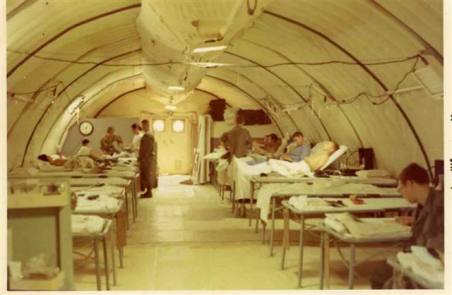
|
The History of the 45th Surgical Hospital
By Robert Muzzio
For Organization Day, 7 June 1969
Organized:
The 45th was first organized on the 7th of June in 1943 at Camp White, Oregon as the 45th Portable Hospital. It was designed to be carried by men, pack animals or vehicles.
WWII:
During WWII, the 45th served in the China Burma India Theater in support of Chinese troops. Hospital personnel endured significant hardship carrying the hospital as far as 200 kilometers through dense tropical jungles.
The 45th experienced nine Japanese bombing raids in China, not to mention the ravages of malaria, dysentery and other tropical diseases.
Typical of its staying power, the 45th was the last surgical hospital to be relieved of duty with the Chinese Combat Command after the Japanese surrender.
....... Deactivated 1945
Korean War:
....... Reactivated 1953.
The 45th served in the Third Winter Campaign and the Summer-Fall Campaign of 1953.
....... Deactivated 1954.
Post Korean War:
The 45th was reactivated 1956 and trained at Fort Sam Houston, Texas for four years and was designated a STRAC unit.
In April 1966 the 45th was the first hospital in the world to be designated a MUST unit. Shortly thereafter, it was alerted for overseas deployment.
Vietnam War:
The main body arrived Vung Tau, South Vietnam by ship, 4 October 1966. The operational site for the 45th was to be the Base Camp of the 196th Light Infantry Brigade near Tay Ninh, South Vietnam.
The advanced party set up at the Tay Ninh Base Camp and proceeded to convert part of a tapioca plantation into a site for the hospital. On 2 November 1966, after several weeks of hard work, the set-up was complete. The personnel pushed to complete set-up in time to support Operation Attleboro, in War Zone C.
On 4 November, 1966, tragedy struck. The 45th’s Commanding Officer, Major Gary Wratten, Medical Corps, was killed during a mortar attack.
On 13 November 1966 the hospital treated the first patient of the Vietnam War in its MUST set-up at Tay Ninh Base Camp.
Additional information to the above by:
Arthur B. Neighbor
Company Clerk
228th Supply and Service Company (DS)
20 July 1966 - 15 May 1967
Recalls that:
On 4 November 1966 the 228th suffered 16 rounds of mortar fire resulting in 1 KIA, 2 severely wounded, and 14 minor wounded. I only mention this fact, as all 17 were seen and handled by you kind folks. The 228th processed all KIA, as we also were the only outfit with a Graves Registration Platoon within 20+ miles. Anyway, it's a small point, but in fact, the 45th treated your first "patients" on 4 November 1966 rather than 13 November 1966.
The date 13 November 1966 was Tay Ninhs' 2nd mortar attack, resulting in 43 KIA, most, but not all from the 196th Light Infantry Brigade..... how many you treated I do not recall. I do know (from that which I heard), that personnel treated were a number more than 1....my memory seeming to recall the number to be at or near 25 -30 and/or more.
Continuing the story.
During the next six months, the 45th supported some to the largest ground operations of the war: Atteleboro, Cedar Falls, Gadsden, and Junction City, all historic engagements. The 45th treated over 2400 patients during this period, the vast majority of whom were severely wounded combat casualties.
Throughout the first year in country, when not treating patients, the personnel worked hard to construct hooches, bunkers, the covered walkway, medical supply warehouse, and many other projects, including relaying the laterite pads for the bubbles.
On numerous occasions during the TET Offensive in early1968, personnel worked around the clock to care for the large number of casualties.
On the evening of 16 February 1968 during a MASS CAL, four 107 MM rockets hit the hospital area. Tragedy struck again, a round that landed behind Pre-Op killed Captain James Susnowski, Medical Corps, while he was attending patients in the Pre-Op bubble. Seven other hospital personnel were wounded during that attack, and Pre-Op, X-ray, A&D, HQ and an OR sustained damage. Personnel continued to treat patients. Later that night, another 107 rocket hit the hospital area, near Pre-Op and injured two more hospital personnel.
On 14 May 1968, during a two hour period, 30 seriously wounded and 24 KIA were brought to the 45th from an operation on Nui Ba Den. After six hours of performing one operation after another in the three ORs, the backlog was reduced to zero.
August and September 1968 were again busy times for the personnel of the 45th. Frequent MASS CALS and rocket and mortar attacks (day and night) were the rule rather than the exception. Surgical teams often worked around the clock to keep up with the heavy patient load, ignoring the incoming rounds.
During the evening of 23 February 1969, the Base Camp came under heavy rocket attack. Forty casualties were sustained throughout the camp, and 28 of them arrived at the 45th in a half hour period. Surgical teams again worked around the clock to care for the casualties.
From March through May 1969, Tay Ninh Base Camp continued to be pounded with rocket and mortar fire by the enemy. During this period, 700 rocket and mortar rounds hit the Base Camp. Seventeen of these rounds landed in the hospital area wounding 12 hospital personnel, killing one civilian employee, and causing significant damage to hooches and other hospital facilities. The 45th’s First Sergeant’s hooch took a direct hit as he slept one evening. Other direct hits included the PA&E Office, the MUST Maintenance Tent and a MUST Ward Box. Miraculously the First Sergeant was not badly wounded. However, a civilian employee in the PA&E Office was killed, and several MUST Maintenance Techs were severely wounded. Throughout this period, MASS CALS were frequent in number and heavy in intensity. In spite of the heavy workload and enemy fire, the morale has remained high and the patients received superior care in the tradition of the 45th Surgical Hospital.
The 45th’s history is full of pride, distinctiveness and is characterized by a spirit of “Can Do”. We can all be justly proud of serving with the 45th Surgical Hospital on this 26th anniversary of the establishment of this very fine unit.
Our mission is SERVICE
Our sustenance is PRIDE
And our results are THE VERY BEST
Thanks Bob
Courtesy of Arthur B. Neighbor
Company Clerk
228th Supply and Service Company (Direct Support)
July 1966 - May 1967
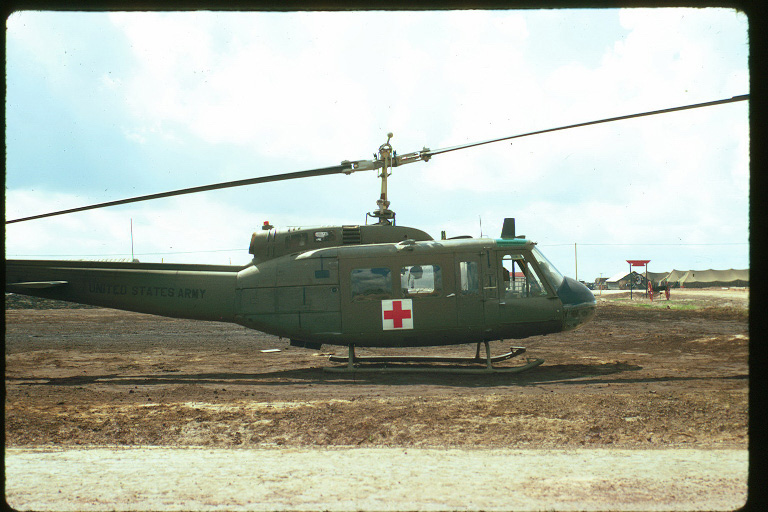
Med Evac Chopper (Huey) with 45th Surgical Field Tents in the background December 1966.
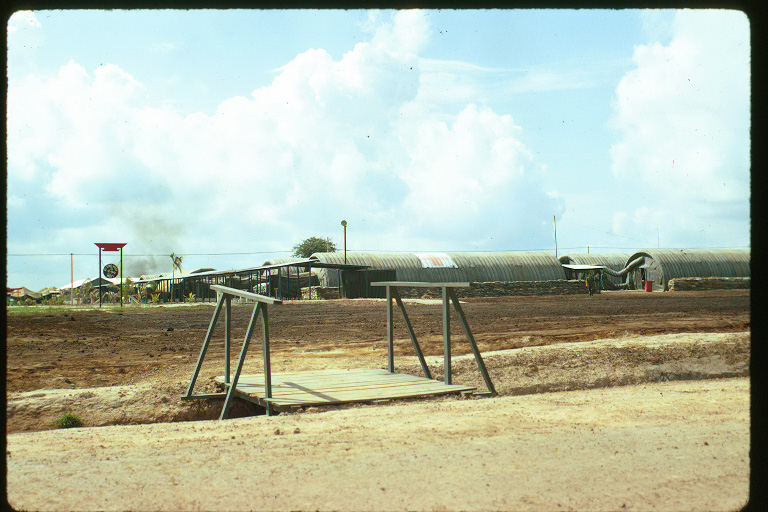
45th Surgical after transition from Field Tents taken on or about March 1967.
You might or might not remember our unit....which is OK....some of our folks don't remember either (CRS) and we are all older and on medications.
We also set up, ran and delivered all Class I products (canned, refrigerated, perishable) goods....including but not limited to Austrailian Lobster Tails (a special request by the 45th for patients). We set up and operated a hot shower point near the airstrip. We ran and operated Stock Control, Class II and IV. In addition we handled specialty items, medical supplies and other for the 45th, while also supporting Attleboro, Gadsden, Cedar Falls and Junction City with field supplies, ammunition, c-rations, not to mention Av Gas and a complete POL yard (Petrol, Oil, Lubricants).......with all remains processed by the 228th GR (Graves Registration) in each operation. I still have a heavy heart remembering how five clerks (myself included) from the 228th helped to unload incoming body bags from the field and transporting same to our GR unit. After two hours of same, I can honestly state, that each and every one of us had a tear in our eye.
Anyway, I didn't get to thank you folks for all the fine work you performed on behalf of not only our unit, but many others as well. So 40+ years later let me say it now........Thanks
Arthur B. Neighbor
Company Clerk
228th Supply and Service Company (DS)
20 July 1966 - 15 May 1967
PS: I do not know if you fine folks know it or not. You were awarded an MUC (Meritorious Unit Citation) for time period 4 October 1966 - 31 May 1969.
We too were awarded an MUC for time period 1 October 1966 - 3 July 1967. Even more interesting, is the fact, that of all United States Army Units in RVN between 1966 - 1970, there were 242 MUC's awarded. However, there are only 9 units whose starting date of award was 1966, of which you were one. The 9 units consisted of the following:
25th Infantry Division and assigned units.
HQ &HQ Artillery Battery 9th Infantry Division
HQ &HQ Detachment 43rd Medical Group
45th Surgical Hospital
553rd Engineer Company....part of 39th Engineer Battalion
572nd Engineer Company...part of 39th Engineer Battliion
506th Supply and Service Company (Direct Support)...part of 266th Supply and Service Battalion (Direct Support)
624th Supply and Service Company (Direct Support)... same
228th Supply and Service Company (Direct Support)... same
To the best of my knowledge the award of above MUCs' does not appear on any one persons DD214, as all had rotated to CONUS prior to issuance and acknowledgement by higher authority.....but the orders do exist, are signed by Westmoreland as a recap and confirmed as such in General Orders #39, HQ, Department of the Army, dtd 20 July 1970.
Arthur Neighbor
Thanks Art
|